Hello Students!
These two days are review day. On 1/22, if you are in periods 1 and 2, then you did your review during class in a reverse musical chair activity. If you are in periods 5 to 8, you are assigned textbook page 463, questions 4-14.
On 1/23, your independent work starts in your textbook page 487, questions 15-30.
Don't forget these are still due as your daily grades! Be sure to attempt them, even if you get them wrong. We will go over selected problems from these on Friday, 1/24.
Thursday, January 23, 2014

10. Angles of Elevation and Depression
1/20. Textbook chapter 8-5, starting on page 464.
Today, we learned two new vocabulary terms: angle of elevation and angle of depression. We then used them in conjunction with trigonometry to solve some real life problems. Pay special attention to examples 1 to 3 in the textbook please.
Here's a website I found that explains it:
http://www.mathsteacher.com.au/year10/ch15_trigonometry/12_elevation_depression/23elevdep.htm
http://www.purplemath.com/modules/incldecl.html
And here's a youtube video I found:
http://www.youtube.com/watch?v=oLsZB1VzxQo
Classwork: page 466 #1-3
Today, we learned two new vocabulary terms: angle of elevation and angle of depression. We then used them in conjunction with trigonometry to solve some real life problems. Pay special attention to examples 1 to 3 in the textbook please.
Here's a website I found that explains it:
http://www.mathsteacher.com.au/year10/ch15_trigonometry/12_elevation_depression/23elevdep.htm
http://www.purplemath.com/modules/incldecl.html
And here's a youtube video I found:
http://www.youtube.com/watch?v=oLsZB1VzxQo
Classwork: page 466 #1-3
7. SOHCAHTOA, 8. Solving Problems with SOHCAHTOA and 9. Word Problems
1/15 to 1/17. Textbook chapter 8-4, starting on page 456.
On 1/15, we started by introducing the three basic trigonometric functions: sine, cosine and tangent. We set up the ratios, or fractions, that they used. In particular, look at example 1 on page 457.
Classwork: page 460 #1,2
On 1/16, we practiced using the trigonometric ratios to solve a problem. In particular, look at examples 3 and 4 starting on page 458 in your textbook.
Classwork: page 4461 #44-49
On 1/17, we practiced solving word problems using trigonometric functions.
Classwork: handout provided.
Here's a couple of websites that explains the basic trigonometry we are learning:
http://www.mathsisfun.com/sine-cosine-tangent.html
http://www.regentsprep.org/Regents/math/algtrig/ATT1/trigreview.htm
Here's a couple of youtube videos I found:
http://www.youtube.com/watch?v=XFh_JC7OSrg
http://www.mathwarehouse.com/trigonometry/sine-cosine-tangent-practice2.php
Don't forget to turn in your notebooks!
On 1/15, we started by introducing the three basic trigonometric functions: sine, cosine and tangent. We set up the ratios, or fractions, that they used. In particular, look at example 1 on page 457.
Classwork: page 460 #1,2
On 1/16, we practiced using the trigonometric ratios to solve a problem. In particular, look at examples 3 and 4 starting on page 458 in your textbook.
Classwork: page 4461 #44-49
On 1/17, we practiced solving word problems using trigonometric functions.
Classwork: handout provided.
Here's a couple of websites that explains the basic trigonometry we are learning:
http://www.mathsisfun.com/sine-cosine-tangent.html
http://www.regentsprep.org/Regents/math/algtrig/ATT1/trigreview.htm
Here's a couple of youtube videos I found:
http://www.youtube.com/watch?v=XFh_JC7OSrg
http://www.mathwarehouse.com/trigonometry/sine-cosine-tangent-practice2.php
Don't forget to turn in your notebooks!
6. Composite Special Right Triangles
1/14, practice day
Hello guys! This session is a practice day. If you missed out, you must come see me for make-up work!
No homework.
Hello guys! This session is a practice day. If you missed out, you must come see me for make-up work!
No homework.
5. Special Right Triangles
1/13, Textbook Chapter 8-3 starting on page 448
Today we look at the special patterns found in two kinds of right triangles. It's all about solving for side lengths of a triangle without using any calculator. How easy that would be!
Here's a website I found to explain it:
http://www.onlinemathlearning.com/special-right-triangles.html (this one has a few videos that's good too)
Here's a couple of youtube videos I found to explain it:
http://www.youtube.com/watch?v=VVKUOdyzQ98
http://www.youtube.com/watch?v=7B1yrRLSRT8
Here's a website you can use to practice more:
https://www.khanacademy.org/math/geometry/right_triangles_topic/special_right_triangles/e/pythagorean_theorem_2
Classwork: handout provided. If you don't have it, pick one up tomorrow!
Remember that your classwork is 50% of your daily grade. Don't miss out!
Today we look at the special patterns found in two kinds of right triangles. It's all about solving for side lengths of a triangle without using any calculator. How easy that would be!
Here's a website I found to explain it:
http://www.onlinemathlearning.com/special-right-triangles.html (this one has a few videos that's good too)
Here's a couple of youtube videos I found to explain it:
http://www.youtube.com/watch?v=VVKUOdyzQ98
http://www.youtube.com/watch?v=7B1yrRLSRT8
Here's a website you can use to practice more:
https://www.khanacademy.org/math/geometry/right_triangles_topic/special_right_triangles/e/pythagorean_theorem_2
Classwork: handout provided. If you don't have it, pick one up tomorrow!
Remember that your classwork is 50% of your daily grade. Don't miss out!
4. Pythagorean Theorem and its converse practice
This is a practice day. If you missed this session, please come see me for make up work.
No homework.
3. Converse of the Pythagorean Theorem
On Jan 9th, we learned about the converse of the Pythagorean Theorem, which are the Pythgorean triples. It is still in your textbook chapter 8-2. Look closely at example 4 in page 443.
Here's a website I found to explain it:
http://www.mathsisfun.com/pythagorean_triples.html
Basically, you are looking at three numbers like these: 3, 5, 4
And ask this question: Can these three numbers form a right triangle?
You then plug it into the Pythagorean theorem formula, choosing the biggest number as "c"
Your answer will be a yes or no.
Here's a youtube video I found as well to explain it:
http://www.youtube.com/watch?v=2Kc1xbC9nAE
Classwork: page 444 #19-27, #16, 18 are extra credit
Here's a website I found to explain it:
http://www.mathsisfun.com/pythagorean_triples.html
Basically, you are looking at three numbers like these: 3, 5, 4
And ask this question: Can these three numbers form a right triangle?
You then plug it into the Pythagorean theorem formula, choosing the biggest number as "c"
Your answer will be a yes or no.
Here's a youtube video I found as well to explain it:
http://www.youtube.com/watch?v=2Kc1xbC9nAE
Classwork: page 444 #19-27, #16, 18 are extra credit
2. Pythagorean Theorem
On Jan 8th, we worked on the concept of Pythagorean Theorem. It is in your textbook chapter 8-2 starting in page 440.
As a review on what it's about and how to work the problems out, see the examples in the textbook. Also, here's a link to great website that explains it as well.
http://www.mathsisfun.com/pythagoras.html
Here's a video that someone made as well in youtube:
http://www.youtube.com/watch?v=AA6RfgP-AHU
Classwork: Page 444 #9-14, 28. Make sure to show your work.
As a review on what it's about and how to work the problems out, see the examples in the textbook. Also, here's a link to great website that explains it as well.
http://www.mathsisfun.com/pythagoras.html
Here's a video that someone made as well in youtube:
http://www.youtube.com/watch?v=AA6RfgP-AHU
Classwork: Page 444 #9-14, 28. Make sure to show your work.
Welcome Back!
Hello everyone!
I'm finally up to updating my blog!
I will post as much as I can. But be sure to keep checking.
Please remember my tutoring hours this semester has been updated to:
M, W, Th, F: 8-845am
T, W: 4-5pm
Some Saturdays I will be available as well.
As a reminder, here is how you will be graded:
Daily grade: 40%
Tests and Quizzes: 25%
Projects and Products: 20%
6wk Common Assessment: 15%
I'm finally up to updating my blog!
I will post as much as I can. But be sure to keep checking.
Please remember my tutoring hours this semester has been updated to:
M, W, Th, F: 8-845am
T, W: 4-5pm
Some Saturdays I will be available as well.
As a reminder, here is how you will be graded:
Daily grade: 40%
Tests and Quizzes: 25%
Projects and Products: 20%
6wk Common Assessment: 15%
Sunday, December 15, 2013


ACP Topics to review
The ACP Test is closed notes! Before you take the Test this week, be sure to review the following topics:
1. Make conjectures - remember when we describe what we see. Be sure to know these words and what they look like: point, line, plane, skew lines, collinear, coplanar, supplemental, linear pair, vertical lines, complementary, segment.
2. Constructions - what they look like, the order to make them, and what they do. Remember the angle bisector, segment bisector, copying angles, copying line segments, constructing perpendiculars on and off the line.
3. Patterns - how to get the equation that describes the pattern. We did this in class last Thursday and Friday.
4. Slopes and equations of lines. Look at this blog's entries on this topic. Make sure you can calculate slope, find equations of parallel and perpendicular lines.
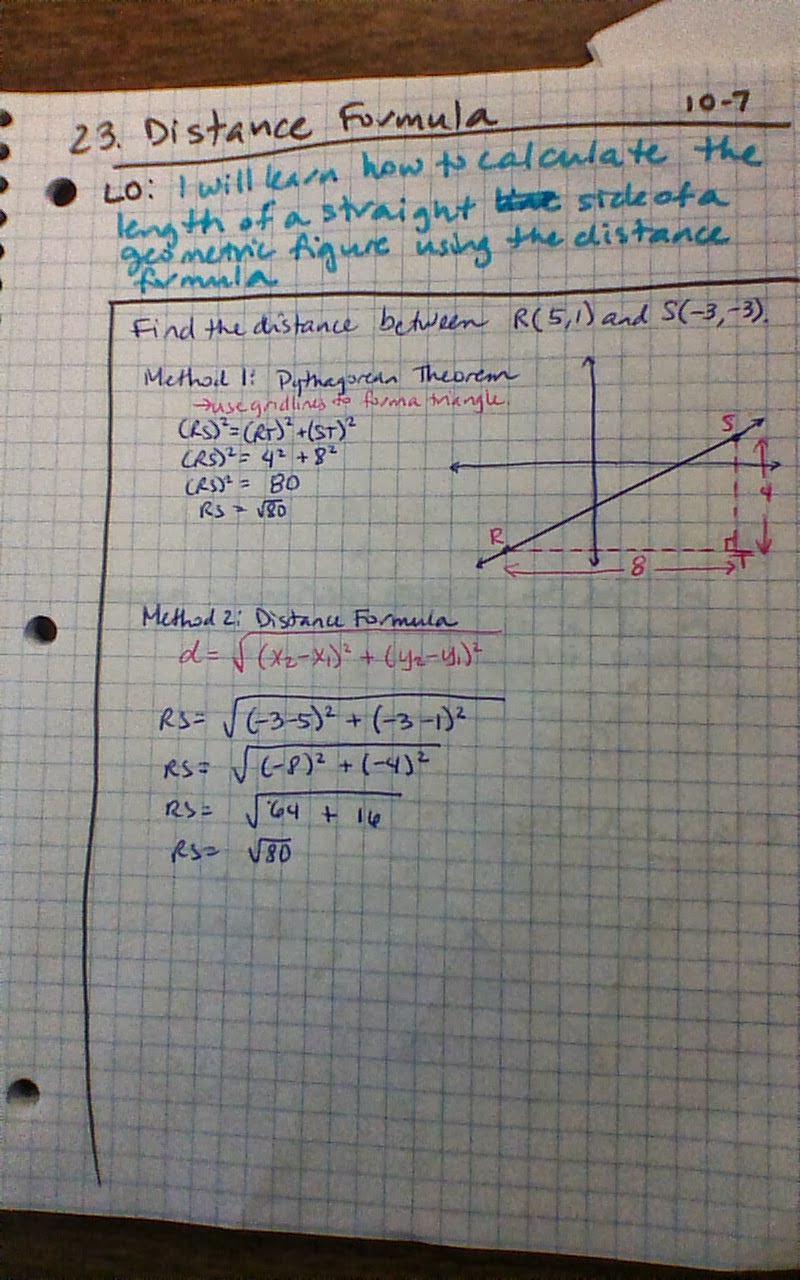
5. Use the formulas for slope, midpoint, distance. Remember that if you get asked for length, you need to use the distance formula! And if you get a perimeter question, that you need to calculate the distance of each side and then add them up.
6. Transversal relationships - remember the corresponding angles, alternate interior angles, alternate exterior angles, consecutive interior angles, and consecutive exterior angles.
7. Triangle congruence - be sure to be able to determine which one is used: SSS, SAS, ASA, AAS.
8. Transformations - remember to multiply when you see the word "scale factor"
9. Similarity - use those proportions and ratios!
10. Proofs. Review that proofs packet.
1. Make conjectures - remember when we describe what we see. Be sure to know these words and what they look like: point, line, plane, skew lines, collinear, coplanar, supplemental, linear pair, vertical lines, complementary, segment.
2. Constructions - what they look like, the order to make them, and what they do. Remember the angle bisector, segment bisector, copying angles, copying line segments, constructing perpendiculars on and off the line.
3. Patterns - how to get the equation that describes the pattern. We did this in class last Thursday and Friday.
4. Slopes and equations of lines. Look at this blog's entries on this topic. Make sure you can calculate slope, find equations of parallel and perpendicular lines.
5. Use the formulas for slope, midpoint, distance. Remember that if you get asked for length, you need to use the distance formula! And if you get a perimeter question, that you need to calculate the distance of each side and then add them up.
6. Transversal relationships - remember the corresponding angles, alternate interior angles, alternate exterior angles, consecutive interior angles, and consecutive exterior angles.
7. Triangle congruence - be sure to be able to determine which one is used: SSS, SAS, ASA, AAS.
8. Transformations - remember to multiply when you see the word "scale factor"
9. Similarity - use those proportions and ratios!
10. Proofs. Review that proofs packet.
Review on Conditional Statements
Be sure to know your conditional statements!
Each sentence can be re-written in "If __(hypothesis)_____, then ___(conclusion)_________" form.
Let's look at this sentence: "Scoring more than 70% on the test will let you pass"
First, identify the conclusion: "you pass"
Then identify the hypothesis: "scoring more than 70% on the test"
Next, put them into an If-Then statement: "If scoring more than 70% on the test Then you pass"
Note that this sentence doesn't make sense, nor does it have good English grammar. So we change and add some words for it to makes sense. Here's what it becomes:
Inverse Statement:
Each sentence can be re-written in "If __(hypothesis)_____, then ___(conclusion)_________" form.
Let's look at this sentence: "Scoring more than 70% on the test will let you pass"
First, identify the conclusion: "you pass"
Then identify the hypothesis: "scoring more than 70% on the test"
Next, put them into an If-Then statement: "If scoring more than 70% on the test Then you pass"
Note that this sentence doesn't make sense, nor does it have good English grammar. So we change and add some words for it to makes sense. Here's what it becomes:
"If you score more than 70% on the test, then you will pass."
This If-Then statement is called the Conditional Statement. We can rearrange the hypothesis and conclusion as well as negate them to have the 4 types of Logic statements in Geometry.
Conditional:
"If you score more than 70% on the test, then you will pass."
Inverse Statement:
"If you do NOT score more than 70% on the test, then you will NOT pass." <--- notice the addition of the word NOT, meaning they got negated.
Converse Statement:
"If you will pass, then you score more than 70% on the test." <--- notice the hypothesis and conclusion got swapped.
Contrapositive Statement"
"If you will NOT pass, then you will NOT score more than 70% on the test." <-- notice that the hypothesis and conclusion got swapped AND each part got negated by using the word NOT.
Be sure you can remember which is which.

Review of Parallel Lines Equations

Now you try:
Find an equation of the line that passes through (–1, –3) and is parallel
to y = 2x + 6.
Monday, October 14, 2013
Project - Map Practice with Distance and Midpoint
Map
Practice with Distance and Midpoint Name: ________________________
|
Restaurants:
·
Burger
King
·
Hardee's
·
McDonald's
·
Chick-Fil-A
·
Bojangles
|
Buildings:
·
City
Hall
·
Post
Office
·
Courthouse
·
Library
·
Armory
|
Stores:
·
Wal-Mart
·
Target
·
Food
Lion
·
Lowe's
·
BP
station
|
1.
Begin
by drawing and labeling your x and y axes on your graph paper. Make sure that your axes cover the entire
area of the page.
2.
Plot
and label the following locations on your map:
|
·
Burger
King at (-2, 3)
·
Hardee's
at (4, 1)
·
City
Hall at (-9, -8)
·
Post
Office at (-3, 8)
|
·
Wal-Mart
at (4, -4)
·
Target
at (-8, 6)
·
BP
station at (1, -10)
|
3.
Bojangles
is located at the midpoint of Burger King and Hardee's. Plot and label Bojangles on the map and write
the coordinates of Bojangles here _______.
4.
The
library is located at the midpoint of City Hall and the post office. Plot and label the library on the map and
write the coordinates of the library here _______.
5.
Food
Lion is located at the midpoint of Wal-Mart and Target. Plot and label Food Lion on the map and write
the coordinates of Food Lion here _______.
6.
Hardee's
is the midpoint between Burger King and Chick-Fil-A. Plot and label Chick-Fil-A on the map and
write the coordinates of Chick-Fil-A here _______.
7.
The
courthouse is the midpoint between the post office and the library. Plot and label the courthouse on the map and
write the coordinates of the courthouse here _______.
8.
Wal-Mart
is the midpoint between Lowe's and the BP station. Plot and label the Lowe's on the map and
write the coordinates of Lowe's here _______.
9.
Burger
King is the midpoint between Target and the armory. Plot and label the armory on the map and
write the coordinates of the armory here _______.
10. (-2, -2) is the midpoint between
McDonald's and City Hall. Plot and label
McDonald's on the map and write the coordinates of McDonald's here _______.
Use your map and your coordinates to
find the distances between the following points of interest:
11. What is the distance between
McDonald's and the BP station?
____________
12. What is the distance between
Wal-Mart and Hardee's? ____________
13. What is the distance between Target
and City Hall? ____________
14. What is the distance between the
armory and the library? ____________
15. What is the distance between
Chick-Fil-A and Food Lion? ____________
16. What is the distance between Lowe's
and Burger King? ____________
17. What is the distance between the
courthouse and Bojangles? ____________
18. What is the distance between
McDonald's and the Chick-Fil-A?
____________
19. What is the distance between
Wal-Mart and the BP station?
____________
20. What is the distance between the
post office and Target? ____________



Saturday, October 5, 2013


Subscribe to:
Posts (Atom)